


Why Pawever Omega Oil Beats the Rest: Omega 3s for Cats 2026
19 September 2026 · Educational only; not a substitute for veterinary advice. If you’re worried about your cat’s health, please see your vet.
Fish oil is one of the best things you can add to your pet’s bowl — or one of the worst, depending entirely on what’s in the bottle. Most pet parents assume all omega oils are broadly the same. They are not.
Some are made from the wrong fish, some oxidise on the shelf, and some are missing an antioxidant so important that its absence has been linked to a genuinely serious condition in cats.
Here’s what’s really going on in the fish-oil aisle — and what to look for instead!
In this guide
Warning: Why Fish Oil Without Vitamin E Can Be Dangerous for Cats
Let’s start with the part almost nobody selling cheap fish oil wants to talk about: steatitis, also known as “yellow fat disease” or pansteatitis.
Steatitis is a painful inflammatory condition of a cat’s body fat. One of its best-documented triggers is a diet high in unsaturated fats (like fish oil) but deficient in vitamin E.
Here’s the mechanism, in plain terms: omega-3 fats are highly prone to oxidation. When a cat takes in a lot of these fragile fats without enough vitamin E to protect them, oxidation can occur inside the body, damaging fat tissue and triggering inflammation. In other words — a fish oil without adequate antioxidants isn’t just less effective; in cats, it can actively contribute to a serious problem.
Signs of steatitis in cats that every omega-oil parent should know:
- Pain or sensitivity when touched, especially around the abdomen and back
- Reluctance to move, jump or be handled
- Lumpy or thickened fat deposits under the skin
- Loss of appetite
- Fever and lethargy
- A dull, greasy or poor coat
This is precisely why we would never sell a fish oil without a proper antioxidant system built in. It isn’t a “bonus.” For a cat, it’s a safety essential.
The Salmon Oil Problem
“Wild-caught salmon oil” sounds premium. Unfortunately, the reality often doesn’t match the label.
Salmon are large fish, high on the food chain. That position means they accumulate more of what’s in the ocean — microplastics, parasites and environmental contaminants — than small fish do. Bioaccumulation is simply how the food chain works, and it works against salmon.
Their omega-3 content is less consistent, particularly in farmed salmon, which makes up much of the global supply. What’s on the label and what’s in the bottle can drift apart.
And a lot of “salmon oil” is a by-product. Much of the cheap salmon oil on the market is rendered from the offcuts of the human salmon industry — a low-cost input, often with minimal antioxidant protection and limited transparency about oxidation levels by the time it reaches your pet.
None of this means salmon is evil. It means salmon oil is an inconsistent, contaminant-prone and often under-protected way to get omega-3s into a cat or dog — when far cleaner options exist.
Why Small Wild Fish Win
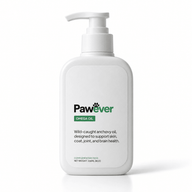
We build Pawever Omega Oil from small, wild-caught anchovies. Being near the bottom of the food chain, they’ve had far less time and opportunity to accumulate contaminants, so they deliver a cleaner, more consistent source of EPA and DHA.
It’s the same principle nutritionists apply to human omega-3s: smaller, shorter-lived fish are the gold standard for purity.

What Actually Separates a Great Omega Oil From a Cheap One
Strip away the marketing and a genuinely superior fish oil comes down to a handful of things most products get wrong:
A real antioxidant system. Not just a token amount of vitamin E, but a proper defence: mixed tocopherols (vitamin E) and astaxanthin. Astaxanthin is one of nature’s most powerful antioxidants, and almost no liquid fish oils include it at meaningful levels. It protects the oil from oxidation and offers its own support for skin, mobility and cellular health. Together, these antioxidants keep the oil active — and, as above, help protect your cat.

No vegetable-oil diluents. Many popular fish oils are quietly padded out with vegetable or seed oils (wheat germ, sunflower and the like). That lowers the cost, lowers the purity, and adds the very omega-6 fats you’re often trying to balance out. We use none. What’s in the bottle is the fish oil and its antioxidants — nothing padding the numbers.
An oxidation-proof bottle and a measured pump. The finest oil in the world is worthless if it oxidises on your counter or is dosed by guesswork. We selected a bottle engineered to prevent oxidation and a precisely measured pump so every dose is consistent and therapeutic — using food-safe materials that don’t leach into the oil or your pet’s food.
Independent batch testing. Every batch is tested at an accredited third-party laboratory for heavy metals, contaminants and label accuracy.
Ask most brands for a certificate of analysis and see what happens; we’ll email you ours.
Here’s How We Compare
| What matters | Typical cheap salmon / white-label oils | Pawever Omega Oil |
|---|---|---|
| Fish source | Large fish (salmon), often farmed or by-product | Small wild fish (wild-caught anchovies) |
| Contaminant risk | Higher (bioaccumulation up the food chain) | Lower (bottom of the food chain) |
| Vegetable-oil diluents | Common (cuts cost, adds omega-6) | None |
| Antioxidant protection | Often minimal or none | Vitamin E and astaxanthin |
| Steatitis safety margin | Reduced if vitamin E is inadequate | Built-in antioxidant system |
| Bottle | Standard (oxidises with air/light) | Oxidation-proof, food-safe, non-leaching |
| Dosing | Teaspoon guesswork | Measured therapeutic pump |
| Testing | Rarely published | Independent batch COA on request |
The Bottom Line
The difference between a fish oil that helps your pet and one that harms them isn’t the word “salmon” or “wild-caught” on the front — it’s the fish species, the antioxidant system, the diluents, the bottle and the testing behind it. For cats especially, a fish oil without adequate vitamin E isn’t a bargain; it’s a risk.
Pawever Omega Oil was built to be the clean, safe, genuinely effective end of that spectrum: small wild fish, a real vitamin E and astaxanthin antioxidant system, zero diluents, an oxidation-proof bottle and a measured therapeutic pump. New to it? Read our introduction to Pawever Omega Oil.

Shop Pawever Omega Oil for Pets →
Small wild fish · Vitamin E + astaxanthin · Oxidation-proof bottle · Independently batch-tested · 60-day money-back guarantee
This product is not intended to diagnose, treat, cure, or prevent any disease.


Leave a comment
This site is protected by hCaptcha and the hCaptcha Privacy Policy and Terms of Service apply.